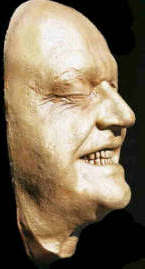
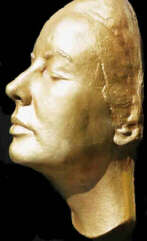
Life casting can be
traced back as far as 2100 BC to the face of an Egyptian king.
Making life masks of famous people gained popularity in 14th century
Europe. It was a way to capture the true image of a person before
the invention of photography. A life cast is much better than
photography because there is a direct connection with the life and
flesh of the famous. It is like owning the celebrity; you can touch
the face and study it from every angle. You can study every pore,
wrinkle, and scar of the famous.
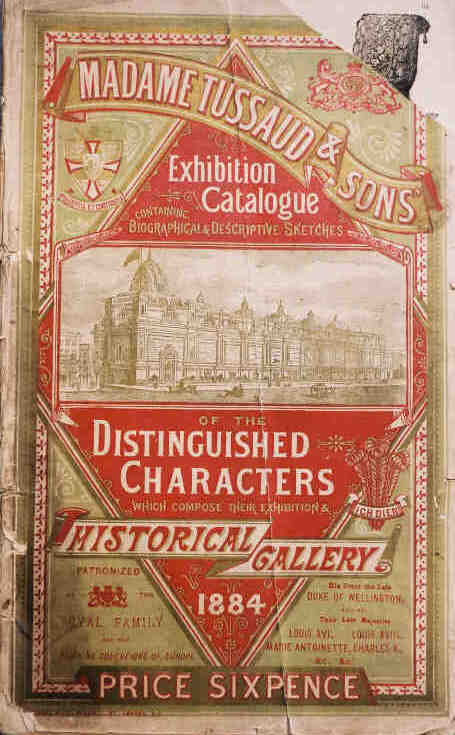 |
The most remarkable
life casting artist was Madame Tussaud. Born in 1760, she
became famous for her London Wax Museum. She started taking
casts of the freshly guillotined heads during the French
Revolution. Some of the casts taken by Madame Tussaud were
Louis XVI, Marie Antoinette, and many of her friends. She
describes this event as "Shreeking with horror, but eager to
retain a
memento." | Sometimes life casts
are used as reference for other works. The Lincoln mask taken in
1860 was used by the sculptor to model the face on the Lincoln
Memorial. This cast was also used by the Disney studio for the
creation of the Lincoln figure for the Hall of the
Presidents.
In Hollywood, Life
Masks are made to design special make up effects for the movies. The
make up artist will cast the stars face so that he can experiment
with various makeup effects without putting the star through the
ordeal. Also, if make up appliances are cast, they can be made from
this
model. | |
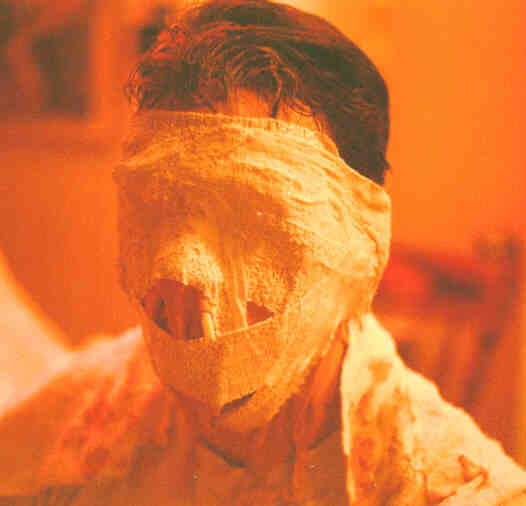 |
To make the mask the artist uses
alginate, a special material that is intended to create a detailed
impression while being more comfortable on the model than materials of the
past. Prior to this development, plaster of Paris was used directly on the
face; this was not flexible at all. It pulled out the subjects eye lashes
and eyebrows and got very hot as it cured. This old method almost killed
Thomas Jefferson. |
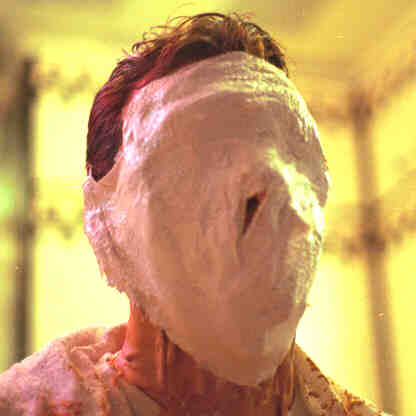 | The artist will prepare the
subjects by greasing the eye brows, pulling back and covering the hair and
usually sticking straws up their nose so they can breathe. Then he layers the
alginate on the stars face. The celebrity must sit very still as the goop
hardens on his face. This material is then backed up by plaster gauze. When set
up, the impression is pulled from the face. Plaster is then poured in to this
mold. When it is taken out we have a positive exact image of the star's face in
3 dimensions. The original mold is destroyed in this process. Other casts are
made from the positive using silicone molds that preserve all the
detail.
Enhancements can be made at this
point. Hair can be sculpted on the mask.The hair style that is unique to the
subject can be faithfully recreated. Eyebrows and facial hair can also be
sculpted. When life masks are cast, the celebrity naturally has his eyes closed,
so historically a life mask collection would look more like a morgue than a
collection of lively vibrant people. The Sculptor can open the eyes and give
back the original character and expression of the
person.
 |
Special effect makeup can be
faithfully recreated to depict the stars in their most famous roles.
Costumes can also be sculpted on the stars to make very impressive
tributes to the
celebrities. | All masks are full scale one to one
direct casts, some are a foot tall, they are very heavy and constructed to last.
The masks are cast in Ultra Cal , the hardest USG casting cement
available.
| All Life Masks and Art
Sculptures | All Movie
Monsters | All Art
sculptures | All
Historical Sculptures
| New Art Sculptures | All Life Masks | Model
Kits | About the Artist
| The Creation
Process |
| Ordering
Information | Links | Privacy
Policy
| The Monster Morgue | Save Money in the U.S. | Service Tech 24/7
|
Contact
Info.
|